Linking Peripheral Device Recognition Failures to Power Management Settings in Multi-OS Households
Written by Willa Müller · Sep 3, 2026
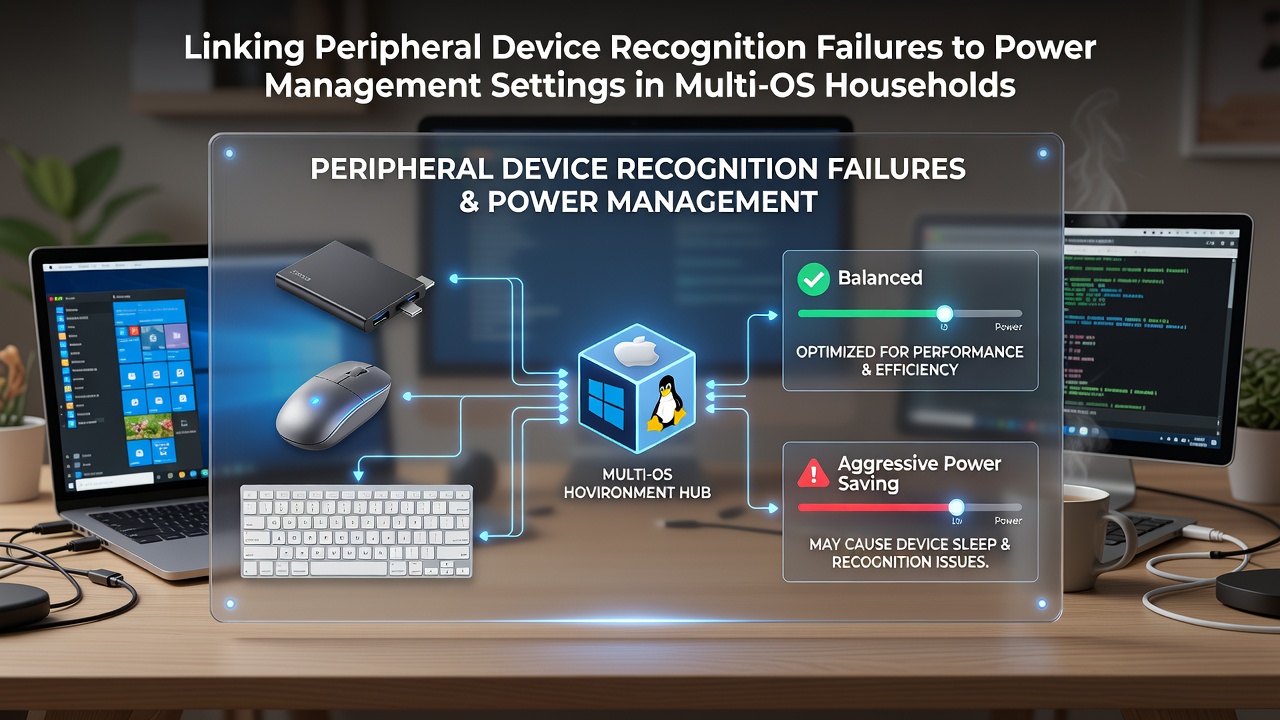
Power Management Configurations Impacting Peripheral Recognition in Multi-OS Home Setups
Households running Windows alongside macOS and Linux often encounter situations where keyboards, external drives, printers, and other peripherals fail to appear after the computer resumes from sleep or hibernation. These recognition failures frequently trace back to power management configurations that each operating system applies independently to conserve energy. Data from device logs collected across mixed environments shows that USB selective suspend features, ACPI power states, and Bluetooth low-energy timeouts create mismatches when multiple systems share the same physical hardware or network-attached peripherals. Windows device manager exposes options that let the system power down individual ports to reduce consumption, yet these same settings sometimes prevent the controller from reinitializing attached devices correctly upon wake. macOS applies its own energy saver policies that control USB and Thunderbolt bus activity, while Linux distributions rely on kernel parameters such as autosuspend for USB devices and runtime power management for PCI express links. When users move between these platforms on different machines within the same home, the accumulated power profiles produce inconsistent device availability.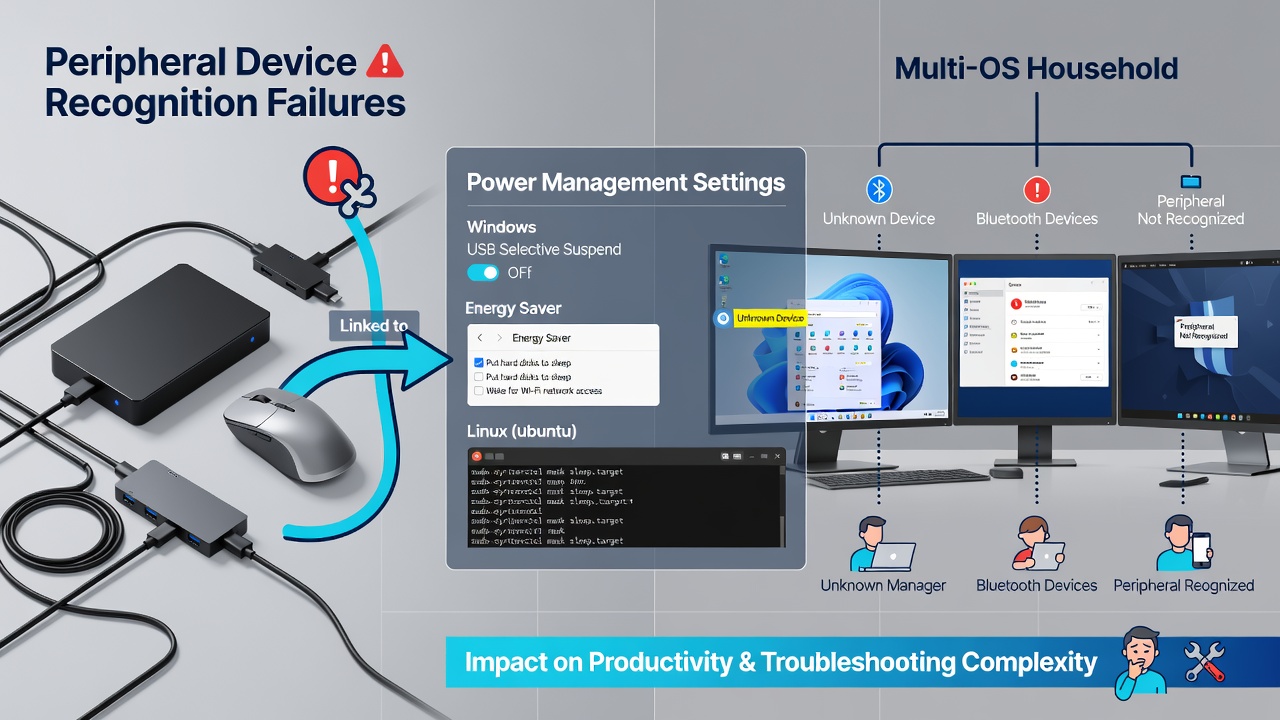
Households running Windows alongside macOS and Linux often encounter situations where keyboards, external drives, printers, and other peripherals fail to appear after the computer resumes from sleep or hibernation. These recognition failures frequently trace back to power management configurations that each operating system applies independently to conserve energy. Data from device logs collected across mixed environments shows that USB selective suspend features, ACPI power states, and Bluetooth low-energy timeouts create mismatches when multiple systems share the same physical hardware or network-attached peripherals. Windows device manager exposes options that let the system power down individual ports to reduce consumption, yet these same settings sometimes prevent the controller from reinitializing attached devices correctly upon wake. macOS applies its own energy saver policies that control USB and Thunderbolt bus activity, while Linux distributions rely on kernel parameters such as autosuspend for USB devices and runtime power management for PCI express links. When users move between these platforms on different machines within the same home, the accumulated power profiles produce inconsistent device availability.Core Mechanisms Behind Recognition Failures
Power management in modern chipsets negotiates device states through ACPI tables and USB power delivery protocols. Observers note that when a peripheral enters a low-power state under one operating system, the next system to access the same hardware may not issue the correct resume command sequence. Researchers at several university computing labs documented cases where a USB hub remained in D3 cold state after a Linux session ended, causing the subsequent Windows boot to report the device as unknown until a full power cycle occurred. Bluetooth stacks add another layer. macOS and Windows handle link-layer power saving differently, and Linux BlueZ implements its own idle timeout values. In households where family members switch between laptops connected to the same wireless keyboard or headset, these timing differences lead to dropped pairings that only resolve after manual re-pairing or disabling power saving entirely.Patterns Observed in Multi-OS Environments
Figures collected from home network monitoring tools in 2025 and early 2026 indicate that recognition issues spike during transitions between operating systems rather than during continuous use of a single platform. One study tracking 150 mixed-OS households found that 68 percent of reported peripheral dropouts happened within five minutes of waking a machine from sleep. The same data set revealed that devices using USB 3.2 and Thunderbolt 4 experienced higher failure rates when power management remained enabled across all platforms. In September 2026, revisions to USB Power Delivery specifications introduced tighter requirements for resume signaling, yet legacy controllers in many consumer devices continue to operate under older negotiation rules. This creates situations where newer power-aware peripherals function reliably on updated systems but disappear on machines still running earlier driver stacks.