Charging Port Instability and Its Ripple Effects on Access Controls in Multi-Tablet Environments
Written by Devon Carter · Nov 12, 2026

Charging Port Instability and Its Ripple Effects on Access Controls in Multi-Tablet Environments
Shared tablet fleets rely on consistent power delivery during charging cycles, yet voltage swings at individual ports have been documented to initiate hardware-level interruptions that propagate through device firmware and reach permission management layers. Research from fleet operators shows these fluctuations often stem from aging infrastructure or simultaneous high-draw sessions across multiple units, creating uneven current distribution that devices register as incomplete power cycles.
Power Delivery Patterns in Grouped Charging Setups
Tablets connected to shared hubs experience voltage variations when ports draw from the same transformer without individual stabilization circuits, and data collected in late 2025 across educational and corporate deployments indicates swings exceeding 0.4 volts trigger firmware checks that reset partial configuration states. Observers note that such events occur more frequently during peak usage hours when devices queue for simultaneous top-ups, whereas isolated charging stations show lower incidence rates according to internal logs from several North American school districts.
Hardware sensors inside modern tablets monitor input voltage as part of their power management routines, and when readings fall outside expected ranges the system logs an incomplete session before resuming normal operation. This logging process can leave temporary markers in the device's state table that later interact with mobile device management agents responsible for maintaining user permissions across the fleet.
Path from Hardware State Changes to Permission Records
Permission drift emerges when these temporary markers influence how management software reconciles local settings with central policies during the next sync interval. Figures from a 2026 industry report compiled by the Consumer Technology Association reveal that fleets experiencing repeated voltage anomalies recorded up to 18 percent more permission mismatches compared with stable power environments, particularly around file access and application launch controls. The process unfolds gradually because each partial power cycle adds incremental inconsistencies rather than causing immediate failures.
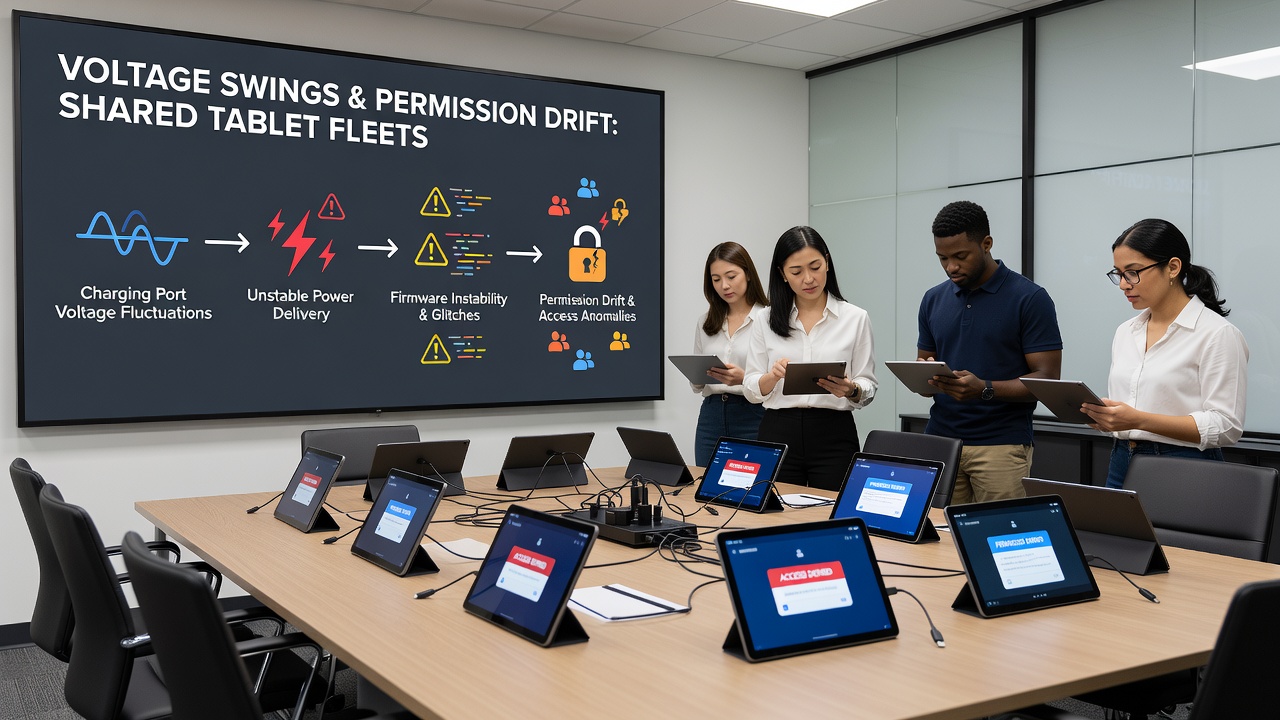
Those who administer large deployments often discover that the drift becomes visible only after several charging cycles accumulate across dozens of units, at which point central dashboards begin flagging devices that no longer enforce the same access rules as their peers. Australian Standards documentation on power quality for information technology equipment highlights similar sensitivities in multi-device installations where voltage stability directly affects operational continuity.
Observed Sequences Across Different Deployment Types
Case studies from corporate environments in Canada demonstrate how a single charging station with fluctuating output affected an entire row of tablets over a two-week period, resulting in staggered permission resets that required manual reconciliation. The pattern typically begins with voltage drops during the final 20 percent of a charge cycle, continues through firmware re-initialization routines, and ends with the management agent pulling an older policy snapshot because the device state appears newer than the last verified record.
European Union cybersecurity guidelines issued by ENISA emphasize the importance of monitoring power characteristics in shared device pools precisely because small hardware variances can influence higher-level security controls over time. Fleet managers who implemented per-port voltage regulation reported measurable reductions in these reconciliation events within the first quarter of deployment, based on telemetry shared at industry conferences held during November 2026.
Monitoring and Mitigation Approaches in Practice
Administrators track these issues through combined power and permission audit logs that correlate voltage events with subsequent policy drift timestamps, allowing identification of problematic charging hardware before widespread inconsistencies develop. Data from such monitoring programs shows that targeted replacement of unstable ports reduces drift incidents by measurable margins across tablet models from multiple manufacturers.
What's interesting is how the interaction between low-level power management and higher-level access controls creates dependencies that standard device health checks often overlook until user reports surface. Organizations maintaining large fleets have therefore begun incorporating voltage telemetry into routine fleet health assessments to catch the early stages of the cascade.
Conclusion
Evidence gathered from operational deployments indicates that voltage swings at charging ports can initiate a chain of state changes capable of reaching permission management systems in shared tablet environments. Organizations that monitor both power delivery metrics and access control consistency maintain tighter alignment across their device populations, while those addressing only one aspect of the chain encounter recurring reconciliation tasks. Continued observation of these interactions supports more stable operation in multi-user tablet fleets as hardware and management practices evolve together.